MASS
M
Mass made easier
Current Mass and Reconciliation times, special liturgies, readings and parish-controlled changes.
One trusted place for the practical and pastoral life of your parish — Mass, Reconciliation, prayer, sacraments, giving, notices and pastoral contact.
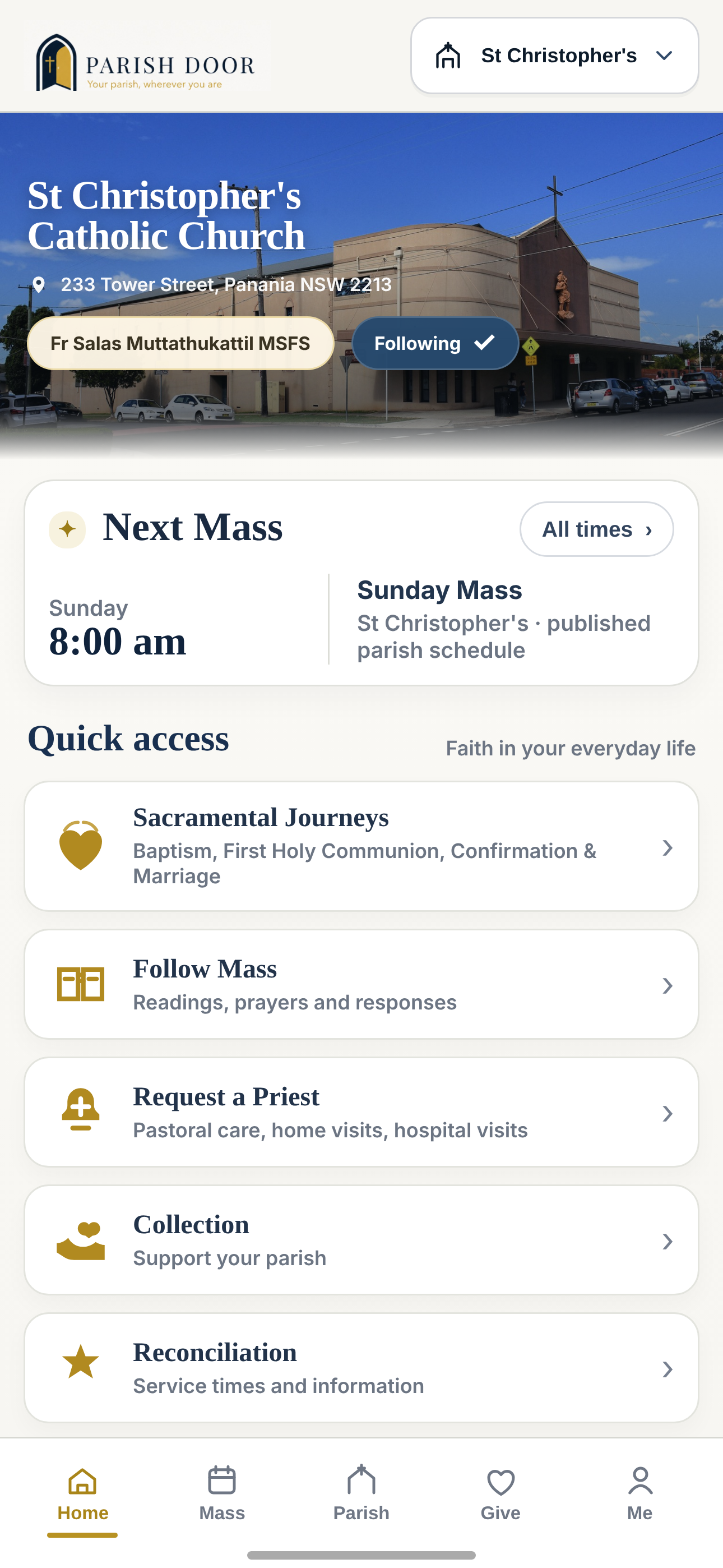
PARISH DOOR is designed to be useful when parish life needs a clear next step — before Mass, during sacramental preparation, while travelling, when you want to help, or when you need to contact the parish pastorally.
Current Mass and Reconciliation times, special liturgies, readings and parish-controlled changes.
Explain what has happened, who needs care, urgency, location and how the parish can respond.
A visible journey from first enquiry through preparation to celebration — not a form that disappears into an inbox.
Newcomer information, volunteering, ministry, notices, giving and other practical paths into parish life.
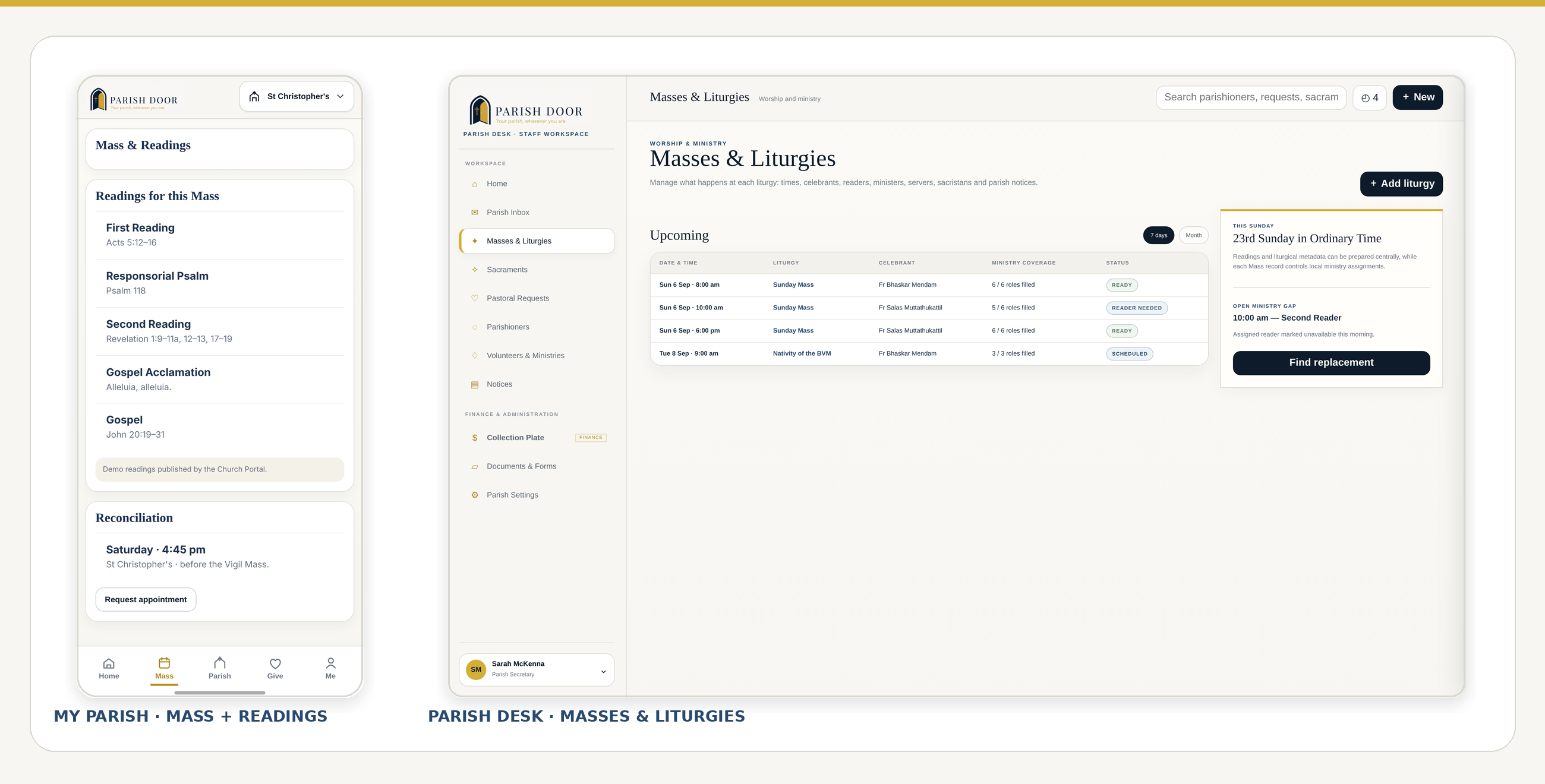
Follow Mass gives you information relevant to the Mass you are actually attending while the parish remains the authoritative source.
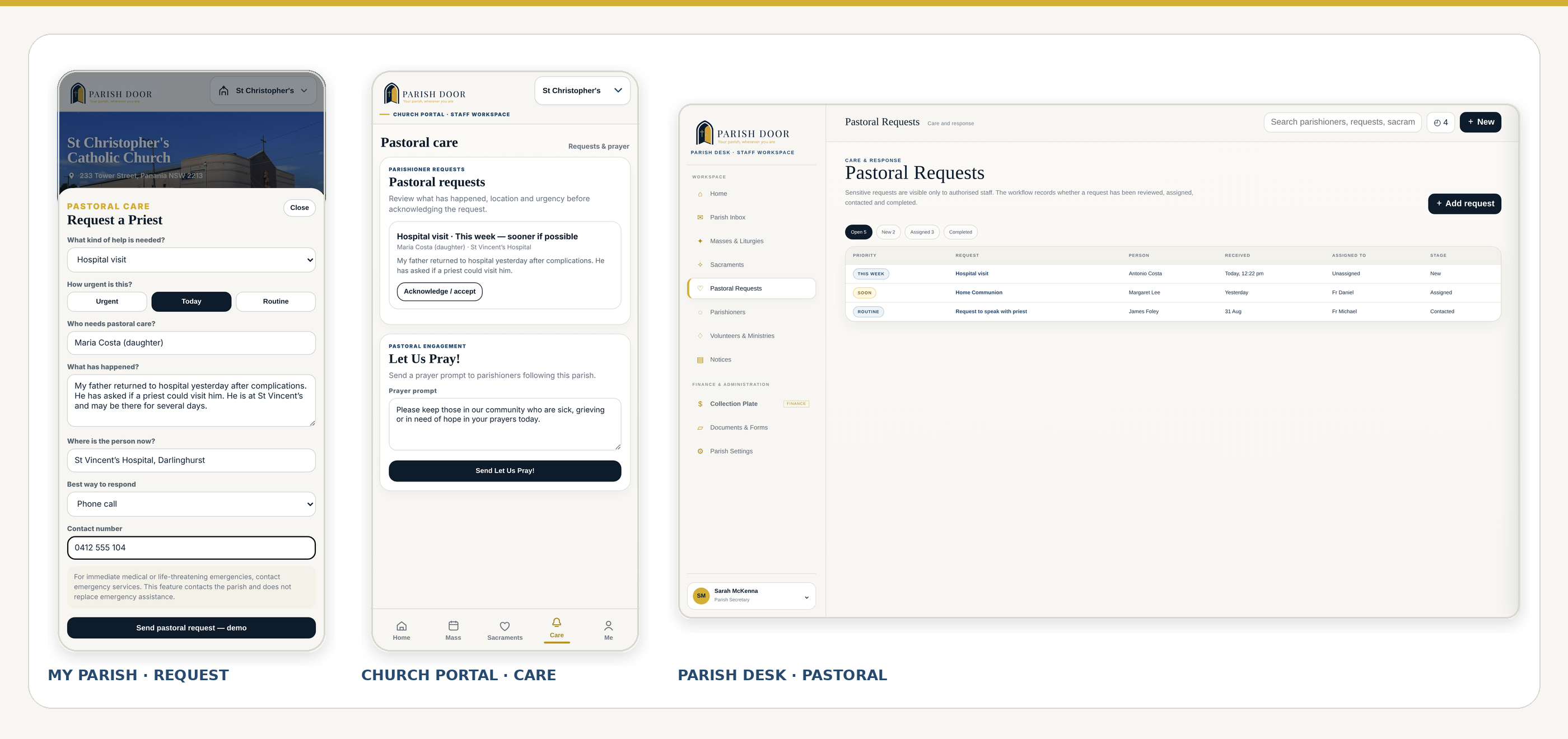
A structured request can give the priest or parish team enough context to respond intelligently while keeping the actual care human and personal.
The strongest benefit is not the online form. It is knowing where your family is in the journey, what has been received, what is still required and the one next step that needs attention.
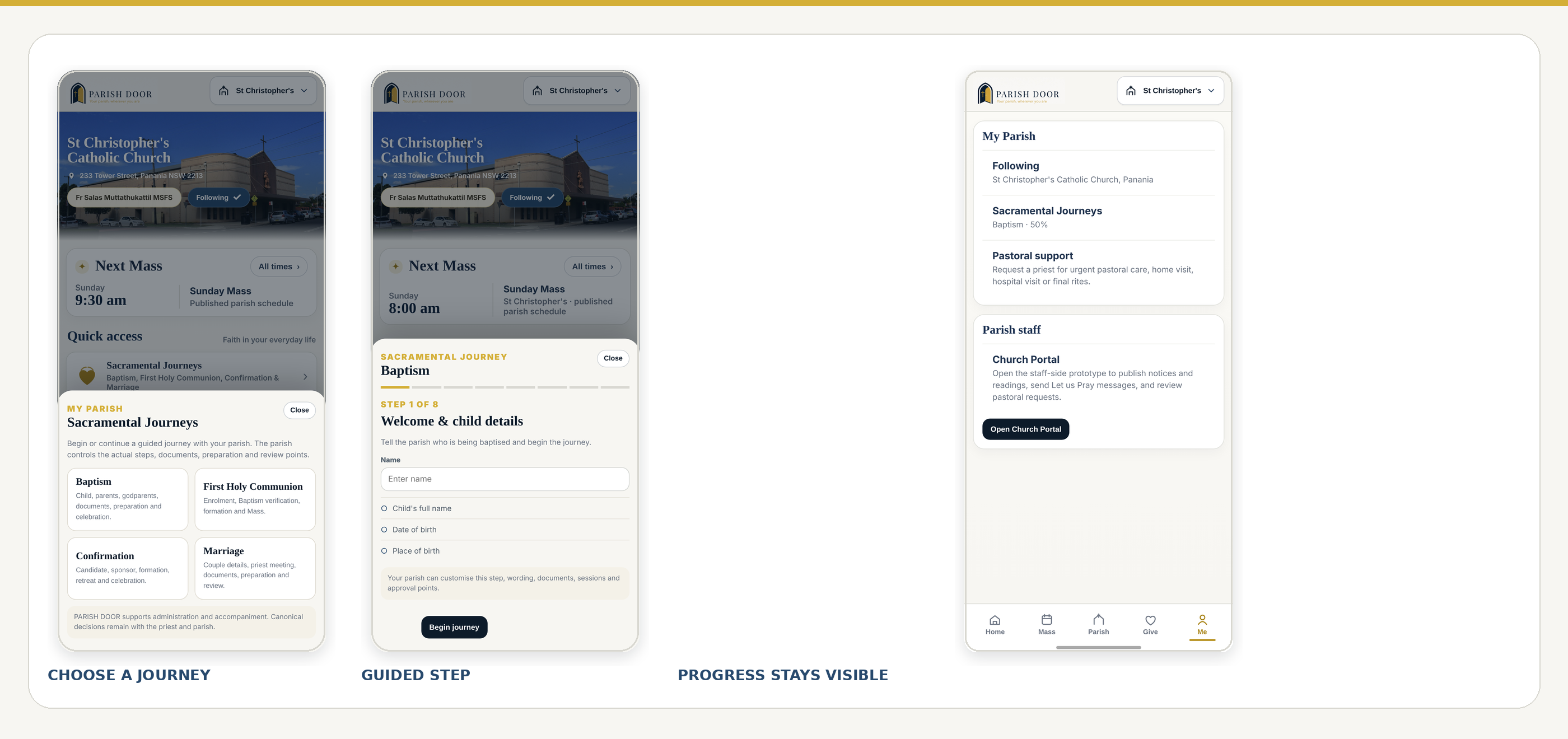
Family details, godparents, documentation, preparation, celebration and parish review.
Enrolment, Baptism verification, formation, reconciliation or rehearsal and celebration.
Candidate details, sacrament history, sponsor, formation, retreat, rehearsal and celebration.
Initial meeting, documents, preparation, liturgy planning and parish or canonical review.
A direct pathway for immediate family contact, planning and pastoral follow-up.
PARISH DOOR helps people participate in the parish; it is not designed to make parish life happen inside the app.
The parish remains the community. The app is a trusted utility around worship, prayer, sacraments, service, giving and pastoral contact.
My Parish gives parishioners a trusted digital front door. Church Portal gives clergy and staff core parish actions on mobile. Parish Desk provides the full desktop operational view. Three surfaces — one parish system.
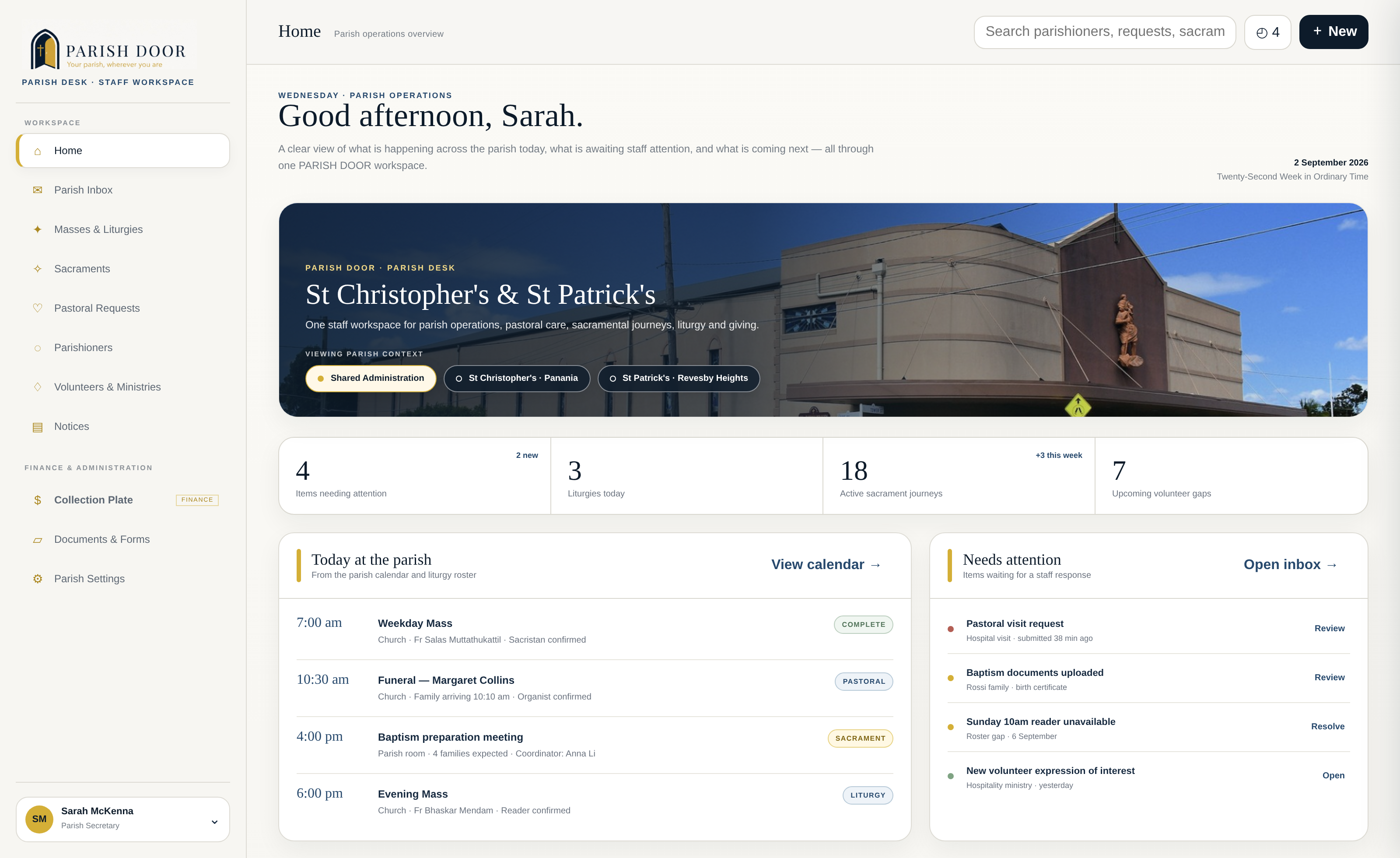
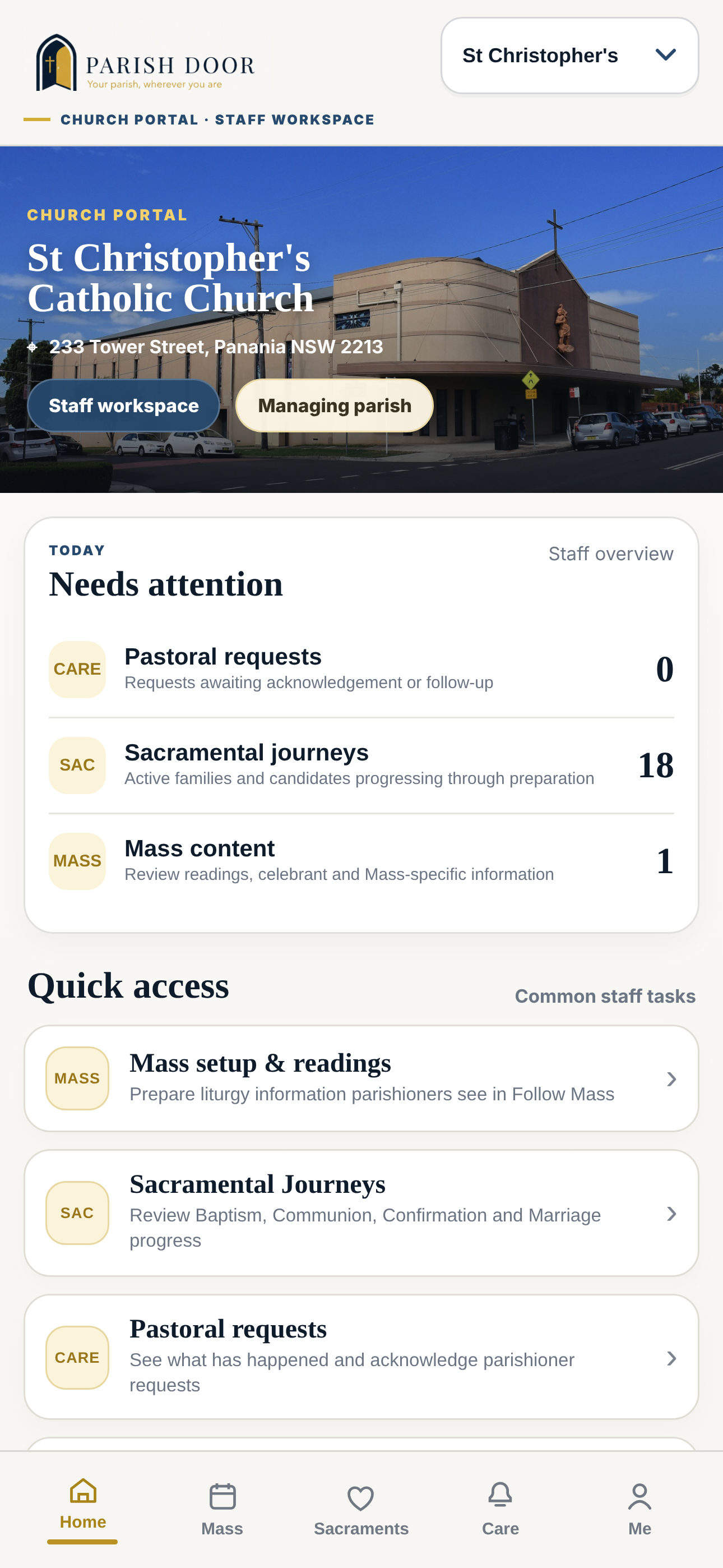
A parish may currently use one channel for Mass times, another for bulletins, phone and email for pastoral care, separate forms for sacraments, spreadsheets for progress, and another system again for giving. PARISH DOOR is designed to make those handoffs coherent.
Mass, Reconciliation, notices, readings and parish information can be managed in the staff suite and published into My Parish.
Pastoral requests arrive with the information a priest or staff member needs to understand the situation before making contact.
Sacramental journeys make progress, missing items, ownership and next actions visible to both family and parish.
Church Portal handles core staff actions on mobile; Parish Desk brings Inbox, liturgies, pastoral care, journeys, ministries, notices, documents, settings and finance into the full desktop workspace.
The suite is strongest because My Parish, Church Portal and Parish Desk operate on the same parish information and workflows. Staff can act from mobile or desktop without creating a second version of the parish, and parishioners never submit into a black hole.
Schedule, celebrant, readings, ministry context and Mass-specific notices can be managed from the appropriate staff surface.
The same verified information is surfaced where the person in the pew needs it.
The parish remains the authoritative source rather than relying on disconnected listings.
Situation, urgency, person needing care, location and preferred response are captured appropriately.
Urgent items can be prioritised, assigned and acknowledged without depersonalising the care.
The priest can begin with what happened rather than first reconstructing the request.
Documents, preparation, dates, next actions and review points stay attached to the same case.
What is complete, what is outstanding and what happens next remain visible.
Fewer “did you receive it?” and “what happens next?” calls and emails.
The staff mobile experience is not a compressed Parish Desk. It concentrates the actions that make sense while clergy and staff are moving through parish life.
The desktop experience is organised around the way a parish office actually works: what is happening today, what needs attention, who owns the next action and where a case sits.
The value is not the number of modules. It is that the modules share parish context, authorised users and a common work model instead of creating another set of disconnected tools.
A single place for work that needs review or response.
Schedules, celebrants, readings, ministry coverage and replacements.
Portfolio progress, missing documents, preparation, dates and next actions.
Sensitive context, prioritisation, assignment and acknowledgement.
Parish records and relevant relationship context.
Opportunities, rostering and ministry coverage.
Parish notices, reusable documents and recurring administration.
Aggregate totals, Mass-level reconciliation, settlements and finance settings.
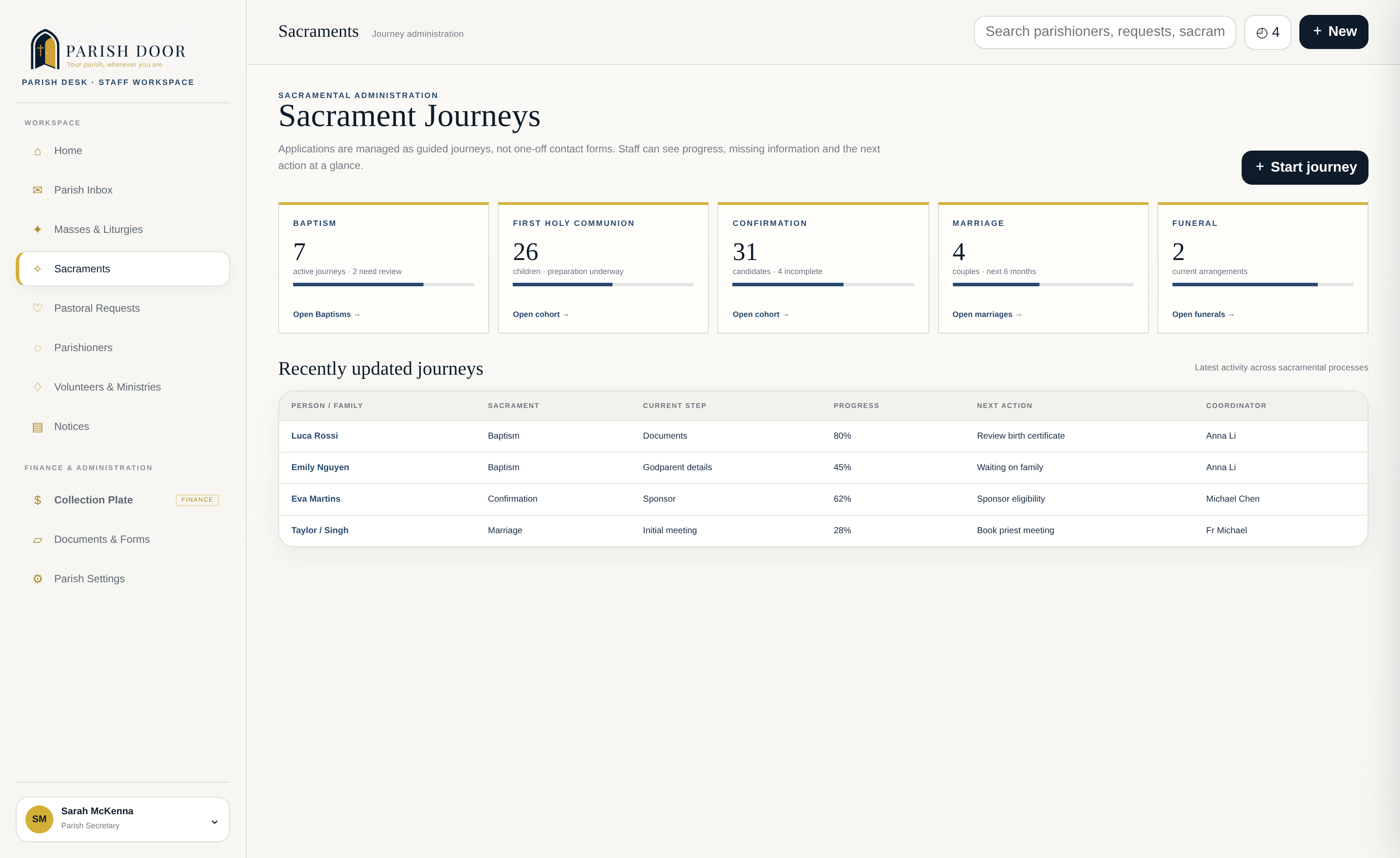
The journey engine is designed to keep information, documents, preparation and next actions attached to the same case while preserving the language and purpose of accompaniment.
The proposal does not assume technology removes pastoral work. It targets the repeatable administrative friction around that work: re-entry, chasing, status enquiries and unclear ownership.
The system can improve the first handoff while keeping pastoral response personal. It is not a triage system deciding whether care is deserved.
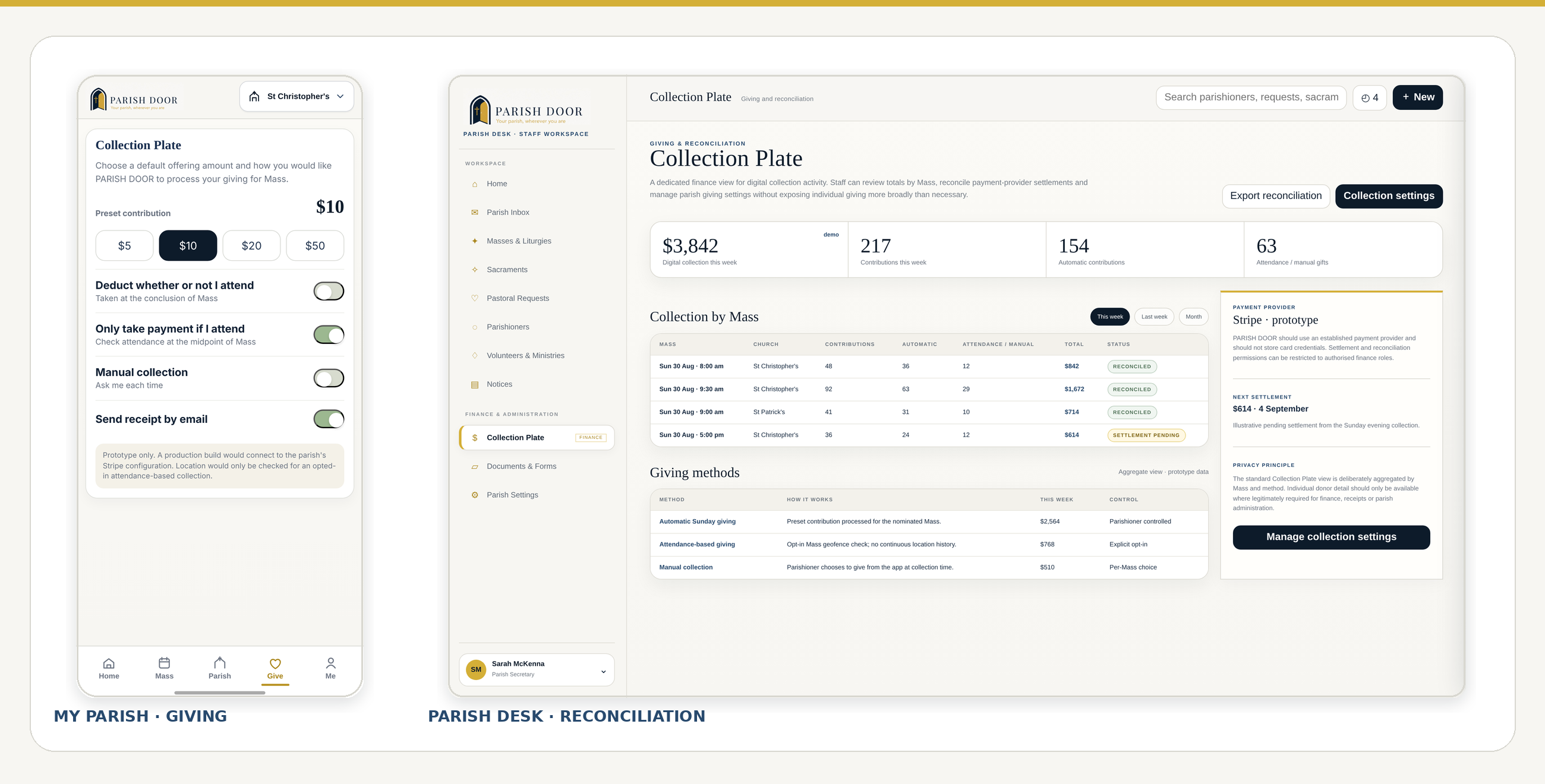
Treat giving as a parish function, not merely a donate button. The parishioner can choose how they give; authorised finance roles get the aggregate view needed to reconcile the collection.
PARISH DOOR is designed to let each person see the depth they need without making every role operate the whole platform.
Pastoral requests arrive with useful information; sacramental cases requiring priestly attention are visible; routine administrative progress does not need to be personally tracked.
A common work queue, sacrament progress, liturgy operations, volunteers, notices, documents and next actions with better continuity when staff change or hand work over.
A potential shared digital standard that can preserve parish identity while enabling role-based access, reusable templates, safeguarding, privacy and finance governance.
The higher the sensitivity of the workflow, the more important the operating rules become. The pilot should prove the core value while privacy, safeguarding, finance and technology controls are agreed.
Parishioner, priest, parish staff, parish administrator and diocesan administrator roles can be separated.
Collect only what the parish needs to respond and progress the requested journey.
PARISH DOOR should not automate canonical eligibility or priestly judgement.
Publication, acknowledgements and significant case status changes should be attributable to authorised staff.
The language remains journey, preparation, review and next step because the purpose is accompaniment as well as administration.
PARISH DOOR should reduce friction around real parish life, not replace pastoral judgement, priestly care or face-to-face community.
The prototype uses St Christopher’s Panania and St Patrick’s Revesby Heights as a realistic two-church design environment. A real pilot would validate workflows, governance, integrations, adoption and staff usability before broader rollout.
Validate parish workflows, governance, required integrations and the minimum viable pilot with clergy and staff.
My Parish, the staff mobile Church Portal and the full Parish Desk with Mass information, notices, pastoral requests, sacramental journeys, Collection Plate and core administration.
Run with a small cohort and measure administration saved, parishioner completion, response clarity and staff usability.
Assess privacy, safeguarding, adoption, support requirements and whether the model should expand to additional parishes.
Prototype screens and operational figures are illustrative demo data. Public parish information is used only to make the prototype realistic and does not imply endorsement or participation by the churches shown or the Catholic Archdiocese of Sydney.

Choose the view that is most useful to you. You can change views at any time from the footer.